

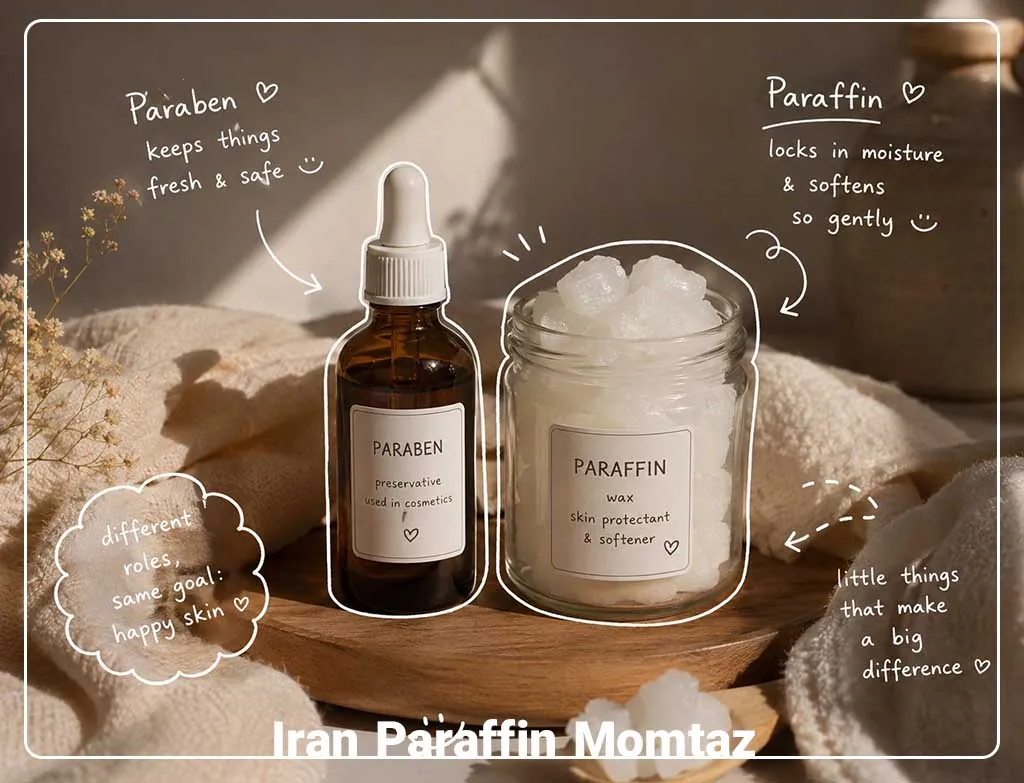
Paraben and Paraffin: What Every Consumer, Formulator, and Buyer Needs to Know
When browsing the ingredient list on a skincare product, two words tend to catch people off guard: paraben and paraffin. They sound similar, occasionally appear in the same product, and have both sparked consumer debate — yet they represent entirely different chemical families with different purposes, different risk profiles, and different roles across industry. Getting these two straight isn’t just academic; it affects purchasing decisions, product formulation strategies, and how confidently you can evaluate the labels on products you use every day.
What Is the Real Difference Between Paraben and Paraffin?
The confusion between paraben and paraffin runs deeper than a similar-sounding name. Both appear frequently on cosmetic ingredient labels, and both have become focal points of “clean beauty” conversations — but for completely different reasons. Parabens are aromatic esters derived from para-hydroxybenzoic acid, synthesized through a controlled esterification process and added to formulations at very low concentrations (typically 0.01%–0.3%) for one purpose only: preventing bacterial and fungal growth. They contribute nothing to skin feel, texture, or moisture retention.
Paraffin, by contrast, is a petroleum-derived saturated hydrocarbon whose role is entirely physical — it seals moisture into the skin’s surface, provides texture, and stabilizes formulation consistency across a wide range of applications. Paraffin does not inhibit bacterial growth; a product relying on paraffin for emolliency still requires a separate preservative system running alongside it. This is precisely why a product can carry a legitimate “paraben-free” label while containing paraffin as one of its primary ingredients — because these two substances address entirely different formulation needs, and neither implies anything about the presence or absence of the other.
How Do Paraben and Paraffin Compare in Chemistry, Applications, and Safety?
The distinction between these two substances extends well beyond their functional role inside a bottle of moisturizer. Examining their chemical structures, regulatory treatment, industrial reach, and evolving health science reveals why both continue to be debated — in very different terms — across markets ranging from luxury skincare to large-scale manufacturing procurement.
What Roles Do Paraben and Paraffin Play in Skincare and Product Formulation?
Parabens and paraffin each solve a specific technical problem that cosmetic and pharmaceutical formulators routinely face — and those two problems are entirely unrelated to one another.
Parabens address microbial risk. Products with high water content — lotions, creams, serums, shampoos — are ideal environments for bacterial and fungal proliferation. Without protection, these formulations can become contaminated within days of opening. Parabens, including methylparaben, ethylparaben, propylparaben, and butylparaben, disrupt the enzymatic activity of microorganisms, halting their reproduction at concentrations that remain far below levels associated with demonstrated health effects in typical use. Their broad-spectrum antimicrobial coverage and stability across a pH range of 4 to 8 made them the preservation system of choice in personal care manufacturing for nearly a century. Methylparaben alone remains the most widely deployed single preservative in global personal care production today.
Paraffin, on the other hand, addresses a skin barrier problem. The outermost layer of the skin — the stratum corneum — loses moisture through transepidermal water loss (TEWL), particularly in cold or low-humidity environments. Paraffin wax creates an occlusive seal over this layer that physically slows evaporation, allowing the skin’s natural moisture to accumulate beneath the surface. This mechanism gives paraffin genuine therapeutic value in managing eczema, severely cracked skin, and chronic dryness. Beyond personal care, its physical sealing and lubricating properties extend into food packaging, candle manufacturing, rubber processing, pharmaceutical ointment bases, and board sizing.
Recognizing that these two ingredients solve different problems — one biological, one physical — gives formulators and buyers a far more useful framework for evaluating products and sourcing decisions than the generic “are they safe?” question tends to provide.
Why Is Methylparaben Still the Most Widely Used Paraben in Personal Care Products?
Of all paraben compounds, methylparaben offers the most balanced performance profile available to formulators. Its short molecular chain makes it highly water-soluble, enabling even distribution through aqueous formulations without costly processing steps. It remains chemically stable across the broad pH ranges that cosmetics typically span, tolerates the heat generated during manufacturing, and demonstrates effective antimicrobial activity against both bacteria and fungi at concentrations as low as 0.1%. Its allergenic potential is also considerably lower than that of longer-chain variants such as butylparaben and propylparaben — two compounds that face EU restrictions due to stronger estrogenic activity. Add to this a cost advantage that makes it attractive for high-volume production runs, and the picture becomes clear: even as brands reformulate away from parabens, methylparaben remains the performance benchmark against which alternative preservation systems are most commonly measured.
How Does Paraffin Wax Lock Moisture Into the Skin’s Surface?
The moisturizing mechanism behind paraffin is physical rather than chemical. Paraffin wax is inherently hydrophobic — it repels water — and when it solidifies on the skin’s surface, it forms a continuous, flexible film that dramatically reduces the rate of moisture evaporation from the epidermis. Clinically, this property is particularly valuable for treating chronic dry skin, cracked heels, and conditions in which the skin’s natural barrier function has been compromised. Paraffin wax baths — where the hands or feet are dipped repeatedly into warm liquid paraffin until several insulating layers have built up — are a staple in physiotherapy and spa treatments precisely because of this effect. In formulated products, paraffin wax additionally contributes slip, gloss, and structural rigidity, making it a functional ingredient in lipsticks, mascara bases, and therapeutic ointments alike.
Is It Common for a Product to Contain Both Paraben and Paraffin Simultaneously?
Far more common than most consumers realize. A standard moisturizer might use paraffin wax as its primary emollient base — creating texture, gloss, and moisture retention — while simultaneously relying on a methylparaben and propylparaben combination to suppress microbial contamination. The two ingredient families operate independently within the same formula; their chemical natures don’t interact in ways that alter each other’s performance. That said, brands repositioning toward the clean beauty segment have increasingly moved to eliminate both at once, replacing parabens with phenoxyethanol or potassium sorbate, and swapping petroleum-derived paraffin for plant waxes such as carnauba, candelilla, or rice bran wax. In pharmaceutical ointment manufacturing and industrial formulation, however, the simultaneous use of both remains entirely standard practice.
Which Everyday Products Most Commonly Contain Paraben or Paraffin?
A practical understanding of where these two ingredients appear in real products transforms label-reading from a vague concern into a targeted, actionable skill. The categories span personal care, food, pharmaceuticals, and industrial manufacturing — and the two ingredients rarely overlap in the same product for the same functional reason.
Products most commonly formulated with parabens:
- Shampoos and conditioners — the high water content creates an ideal microbial environment; parabens offer cost-effective, broad-spectrum protection
- Body lotions and moisturizing creams — extended shelf life demands robust preservation throughout the product’s distribution and use lifecycle
- Liquid foundations, mascaras, and water-based makeup — water-in-oil emulsions are particularly vulnerable to contamination once opened
- Toothpastes and mouthwashes — especially in conventional oral care formulas where aqueous content is dominant
- Topical pharmaceutical creams and ointments — prescription and OTC wound treatments, antifungal preparations, and medicated gels
- Deodorants and roll-on antiperspirants — a historically common use, now declining as formulations shift
- Canned and packaged food products — food-grade parabens are approved as additives (E214–E219 in the EU) in select markets
Products most commonly formulated with paraffin:
- Candles — paraffin wax accounts for the majority of global candle production by volume
- Lipsticks and lip balms — for structural integrity, application smoothness, and surface finish
- Food coatings and packaging — applied to fresh produce, cheese rinds, and confectionery in food-grade form
- Pharmaceutical ointment bases — paraffin forms the semisolid carrier foundation for many topical drug preparations
- Hair pomades and styling waxes — providing hold, shine, and definition
- Industrial applications — rubber compounding, board sizing, electrical insulation, and metal processing across manufacturing sectors
How Can You Identify Paraben and Paraffin on Ingredient Labels Before You Buy?
Most discussions about paraben and paraffin focus on chemistry and health debates, but few address the practical challenge that consumers and procurement teams face most often: actually spotting these ingredients on a label. Cosmetic products use INCI (International Nomenclature of Cosmetic Ingredients) — a technical naming convention that renders familiar substances unrecognizable to anyone without a chemistry background. The following guide closes that gap.
- Scan for any word ending in “-paraben” — Methylparaben, ethylparaben, propylparaben, butylparaben, isobutylparaben, and isopropylparaben are the most frequently used. Any of these on an ingredient list confirms a paraben preservative is present, regardless of how the product is marketed on the front label.
- Know paraffin’s INCI variants — Solid paraffin is labeled as “paraffin” or “paraffin wax.” Liquid paraffin (highly refined mineral oil) appears as “paraffinum liquidum” on EU-compliant labels and as “mineral oil” on US labels. The related derivative microcrystalline wax is listed as “cera microcristallina.”
- Pay attention to ingredient position — Cosmetic labels list ingredients from highest to lowest concentration. Paraffin appearing near the top indicates it is a primary base ingredient; near the bottom suggests a minor role. Parabens always appear in the lower portion of any ingredient list because their active concentrations are inherently low.
- Never treat “paraben-free” and “paraffin-free” as equivalent claims — These statements are fully independent. A product bearing one claim has made no statement whatsoever about the other substance. Verify each separately if both matter to your decision.
- Cross-reference with a trusted ingredient database — Tools like EWG Skin Deep, INCI Decoder, and CosDNA let you search any ingredient instantly and review its function, safety rating, and regulatory standing across major markets before completing a purchase.
Paraben vs. Paraffin — How Do They Compare Across Key Properties?
Placing paraben and paraffin side by side removes the ambiguity that phonetic similarity creates. Despite occasional overlap in the industries that use them, these two compounds diverge sharply in origin, function, safety debate, and the regulatory frameworks applied to their use. The comparison below draws those distinctions in concrete terms.
| Property | Paraben | Paraffin |
|---|---|---|
| Chemical family | Ester (aromatic organic compound) | Alkane (saturated hydrocarbon) |
| Primary source | Synthetic esterification of para-hydroxybenzoic acid | Petroleum refining / crude oil dewaxing |
| Main function | Antimicrobial preservative | Emollient, occlusive film-former, texture base |
| Physical form | White crystalline powder | Solid wax (refined) or clear liquid (liquid grade) |
| Typical industries | Cosmetics, pharmaceuticals, food additives | Cosmetics, candles, food coatings, pharma, industrial |
| Key health concern | Weak estrogenic activity; hormonal disruption risk | Generally safe; PAH impurities in low-grade variants |
| Regulatory status | Long-chain forms restricted in the EU | FDA and EFSA approved; food/pharma grades cleared globally |
| Environmental concern | Detected in waterways; ecotoxicological risk | Petroleum origin; carbon footprint implications |
| Common alternatives | Phenoxyethanol, sodium benzoate, potassium sorbate | Carnauba wax, candelilla wax, beeswax, rice bran wax |
This comparison makes two things immediately clear: first, that the substances being debated serve completely different roles; and second, that the type of risk associated with each requires a distinctly different response — whether from regulatory bodies, brands developing cleaner formulations, or buyers evaluating sourcing options.
Summary: What Paraben and Paraffin Really Mean for Your Decisions
Paraben and paraffin represent two distinct chapters in the story of industrial chemistry’s role in consumer products. Treating them as interchangeable — or assuming one’s presence implies the other’s — leads to poor purchasing decisions, inaccurate label claims, and missed opportunities for smarter product formulation.
Parabens are preservatives with a century-long track record, now facing mounting regulatory scrutiny and shifting consumer expectations. The EU has restricted several long-chain variants, and while the scientific debate around their estrogenic activity continues, market pressure has pushed many brands toward alternative preservation systems. For formulators, achieving the same broad-spectrum protection without parabens remains a genuine technical challenge — one that “paraben-free” claims on the front label often obscure.
Paraffin carries a different set of considerations. As a petroleum-derived ingredient with one of the broadest industrial footprints of any refined petroleum product, it has reliably served manufacturers across food, pharmaceutical, cosmetic, and heavy industrial sectors for well over a century. Fully refined paraffin — the grade appropriate for cosmetic and pharmaceutical applications — presents a well-characterized safety profile backed by established global regulatory approval. For businesses sourcing paraffin at volume, grade specification and supplier reliability are what ultimately determine product performance and regulatory compliance. The companies that get this right consistently are the ones who start the procurement conversation with technical requirements, not with price.
Frequently Asked Questions About Paraben and Paraffin
Q
Are paraben and paraffin the same substance?
No — they are chemically unrelated compounds that happen to share a partial phonetic resemblance. Paraben is an ester of para-hydroxybenzoic acid used exclusively as a preservative. Paraffin is a petroleum-derived saturated hydrocarbon used as an emollient, coating agent, or structural ingredient across multiple industries. Their chemistry, function, industry applications, and regulatory treatment are entirely different. A product can freely contain one without the other, and the two serve no overlapping functional purpose within a formula.
Q
Is paraffin safe to apply to skin?
Properly refined cosmetic-grade or pharmaceutical-grade paraffin — particularly liquid paraffin (paraffinum liquidum) — has an established safety record accumulated over decades of use in skincare and medical formulations. It is non-sensitizing in the vast majority of users and holds approval from both the FDA and the EFSA for topical and food-contact applications. The safety concerns that do exist relate primarily to low-grade or unrefined industrial paraffin, which may contain polycyclic aromatic hydrocarbon (PAH) impurities. These concerns do not apply to properly refined, specification-grade material — which is precisely why grade selection matters when sourcing paraffin for any regulated application.
Q
Why do so many products now advertise “paraben-free”?
The “paraben-free” marketing claim emerged from consumer concern triggered by early 2000s research demonstrating that parabens could exhibit weak estrogenic activity in laboratory conditions. Although regulatory bodies in most markets continued permitting parabens within defined concentration limits, public perception shifted — particularly in Europe, where several long-chain parabens were subsequently restricted. Natural and clean beauty brands adopted “paraben-free” as a point of differentiation, and the claim eventually migrated into mainstream product lines. Worth keeping in mind: the preservative alternatives now used in place of parabens — phenoxyethanol, methylisothiazolinone, and others — carry their own safety profiles that also warrant independent evaluation.
Q
Can long-term paraben exposure increase cancer risk?
The relationship between paraben exposure and cancer — particularly breast cancer — remains one of the most actively debated questions in cosmetic safety science. Research has confirmed that parabens penetrate the skin and accumulate in human tissue, and have been detected in urine samples from populations with no obvious occupational exposure. However, as of the current scientific consensus, no peer-reviewed study has established a direct causal link between the use of paraben-containing cosmetics and the development of cancer in humans. The EU’s Scientific Committee on Consumer Safety maintains that methylparaben and ethylparaben, applied within approved limits, do not present a carcinogenic risk. The longer-chain variants — propyl- and butylparaben — face tighter restrictions due to their greater estrogenic potency.
Q
What are the main types of paraffin and how do they differ from each other?
Paraffin is classified primarily by its degree of refinement and physical state. Fully refined paraffin wax — with an oil content below 0.5% — is the purest solid form: white, odorless, and appropriate for food-contact, cosmetic, and pharmaceutical-grade applications. Semi-refined paraffin retains slightly higher oil content and residual color, suited to industrial uses where absolute purity is secondary to cost-efficiency. Slack wax is the least refined solid form, used in rubber compounding, board sizing, and certain industrial coatings. Liquid paraffin — also designated paraffinum liquidum or white mineral oil — is a distinct, separately refined product category used in cosmetics, pharmaceutical ointments, and food-processing environments. Each grade carries its own regulatory compliance requirements, and substituting one for another without verifying the technical specification is among the most common and consequential sourcing errors in paraffin procurement.